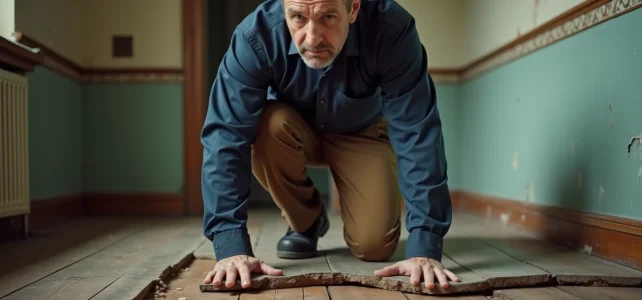
A wooden floor that gives way does not always announce itself with a spectacular creak. The warning signs of a floor collapse often manifest discreetly, over months, sometimes years, before the break. Knowing how to read them requires understanding the mechanical behavior of the joists, the interaction between load and span, and the biological or moisture-related pathologies that undermine the load-bearing section of the wood.
Loss of joist section: the factor that visual inspection misses
The load-bearing capacity of a wooden floor directly depends on the net load-bearing section of the joists. A joist attacked by wood-eating insects (woodworm, longhorn beetles) or by a wood-decaying fungus (dry rot, coniophore) loses material without the visible surface deforming. We regularly observe joists whose core has been reduced to powder while the facing remains intact.
Punch testing remains the most reliable field method. Healthy wood resists indentation, while degraded wood gives way under moderate pressure. If the screwdriver blade penetrates more than a few millimeters, the loss of section is significant. On low-height joists (typically in Haussmannian building floors), a reduction in section of about one-third already compromises the bending strength under working load.
We detail the signs of imminent collapse of a wooden floor on Alpha Immobilier, where the distinction between superficial degradation and structural damage is well explained.
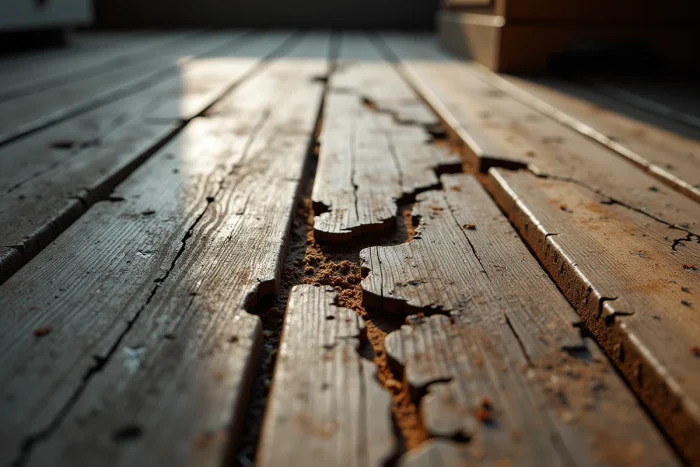
Another discreet indicator: the presence of fine sawdust at the base of walls or under baseboards. This sawdust, often confused with construction dust, betrays ongoing larval activity. Additionally, exit holes of a few millimeters on exposed wood confirm the diagnosis.
Cracks and deformations: distinguishing normal creep from a distressed floor
Every old wooden floor exhibits a slight deflection in the mid-span. This natural creep does not indicate collapse. The problem begins when the deflection increases noticeably over a few months, or when it is accompanied by secondary signs.
Three indicators to cross-reference to assess severity:
- Cracks at 45 degrees originating from door or window corners, indicating that the structure is deforming under load and transmitting abnormal stresses to load-bearing walls or partitions.
- Doors that no longer close or scrape the floor on one side, indicating differential settling of the floor relative to the masonry.
- Visible separation between the baseboards and the floor, or between the floor and the peripheral walls, indicating recent vertical movement.
A marble placed on the floor that consistently rolls toward the same point provides a rough but telling indication of tilt. If the phenomenon is recent and progressive, we recommend installing monitoring devices (crack gauges, simple dated pencil marks) to objectively track the evolution.
Moisture and wooden floors: the most common ruin scenario
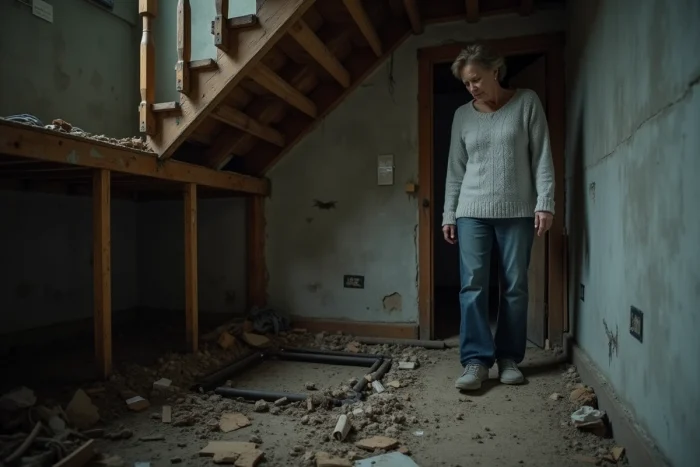
Chronic moisture is the primary cause of the ruin of wooden floors in old buildings. An undetected pipe leak, a lack of waterproofing at the base of a wall, or rising damp is enough to keep the wood’s moisture content above the critical threshold, conducive to fungal development.
Wood with a moisture content consistently exceeding 20% becomes a breeding ground for dry rot. This fungus decomposes cellulose and transforms the wood into a crumbly, brittle material that can no longer bear any load. The problem is that dry rot often develops out of sight, in wall linings, between joists and the ceiling of the lower level.
Warning signs related to moisture not to be overlooked:
- A persistent mushroom smell in a room, even after prolonged ventilation.
- Dark stains or localized warping of the floor covering (parquet, linoleum), indicating water accumulation under the floor.
- Stains or blisters on the ceiling of the lower floor, often the first visible sign of a leak affecting the joists.
- A hollow or soft sound when stepped on, where the wood previously responded with a solid and crisp sound.
Recent field experience reports confirm that prolonged water damage is the most underestimated degradation factor in condominiums. Late detection exacerbates costs and complicates the issue of responsibility between private and common areas.
Abnormal noises and vibrations: what the floor tells under load
A wooden floor always makes noise. The distinction between benign squeaking and structural creaking depends on the context and location.
A regular squeak, reproducible in the same spot, generally indicates play between boards or between a board and a joist. It does not present an immediate risk. In contrast, a dull and sudden creak under static load (heavy furniture, filled bathtub) warrants immediate investigation, as it may indicate partial joist failure or a joint pull-out.
Excessive vibrations during passage are another marker. A floor that “shakes” unusually under a person’s weight, when it did not do so before, signals a loss of rigidity. This phenomenon results either from a reduction in section (biological attack) or from a disconnection of bracing elements (struts, battens).
When several of these signals converge (progressive deflection, noises under load, signs of moisture), assessment by a structural engineering firm is essential. A delayed diagnosis of a few weeks can turn a targeted reinforcement into a complete underpinning project, with costs and complexities that are incomparable.
Prevention involves regular inspections of crawl spaces, attics, and wall linings, targeting the wood-masonry junction areas where moisture concentrates. A floor that appears stable on the surface may conceal advanced degradation of its supports. Vigilance regarding the first signs, even discreet ones, remains the best lever to avoid sudden failure.