In France, nearly 60% of public schools use at least one digital application for student tracking, according to a survey by the Ministry of National Education conducted in 2023. However, some academies prohibit the use of private platforms, citing the protection of personal data, while others are multiplying experiments with artificial intelligence to optimize educational support.
The rise of these tools creates disparities in access and usage between institutions, but also within educational teams themselves. Issues of confidentiality, inclusivity, and pedagogical effectiveness are central to the debate, as digital solutions become firmly established in the educational landscape.
How artificial intelligence and digital tools are reshaping daily educational tracking
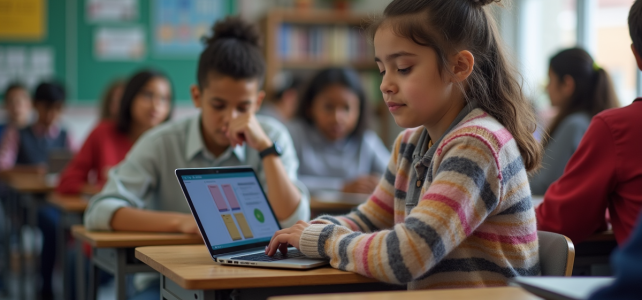
The digital transformation is no longer limited to equipping classrooms or distributing a few tablets. School applications are shaking up habits, driven by the emergence of artificial intelligence. Teachers see their daily routines evolve: automated data analysis now allows for quicker identification of each student’s specific needs, continuously adapting their support. Learning platforms personalize the learning journey, adjusting exercises and resources according to progress, pace, or detected difficulties.
Solutions like Oze92 enable centralized tracking, simplifying the exchange of information between teachers, families, and students. The homework diary, grades, absences: everything is displayed in real-time, providing a clear and shared view for everyone. The health crisis accelerated this movement: accessible learning beyond the walls has become essential, ensuring continuity even during school closures.
The introduction of these educational technologies does not come without discussion. Where should the line be drawn between automation and human support? Teams are questioning the right balance, the role of the teacher in this new framework. But the momentum does not wane: educational technology is becoming a true lever for innovation, differentiation, and democratization of access to knowledge. Practices are changing, driven by the digital education strategy and the energy of on-the-ground actors.

Issues, challenges, and perspectives: what digitalization really changes for students, teachers, and families
The massive arrival of educational technologies disrupts traditional benchmarks. The question of personal data protection becomes central: the collection of information about students raises concerns about privacy, individual responsibility, and the need for solid regulation. The Ministry of National Education must set the tone, establish a transparent and robust framework to maintain everyone’s trust.
Continuous training for teachers is no longer optional. Mastering digital usage is now part of the profession. For some, this technological shift can generate doubts, sometimes even a sense of exclusion. But mutual support and sharing experiences help overcome hesitations and transform these tools into genuine pedagogical levers.
For students, access to a variety of digital resources fuels the desire to learn. School applications stimulate curiosity, develop critical thinking, and encourage creativity and autonomy. Communication between families and educational teams evolves: more transparent and fluid, it makes school tracking clearer and strengthens parental engagement, an asset for everyone’s success.
Three challenges structure the debate around digital usage in schools:
- Respect for ethics and privacy: a permanent challenge.
- Development of critical thinking: placing the student at the heart of the system.
- Training for teachers: a condition for the effectiveness of digital tools.
Digital education is here to stay, not as a mere trend, but as the new backbone of daily school and family life. Benchmarks are changing, boundaries are shifting: the classroom is opening up, dialogue is intensifying, and everyone can now choose to invent their own path within the connected school.