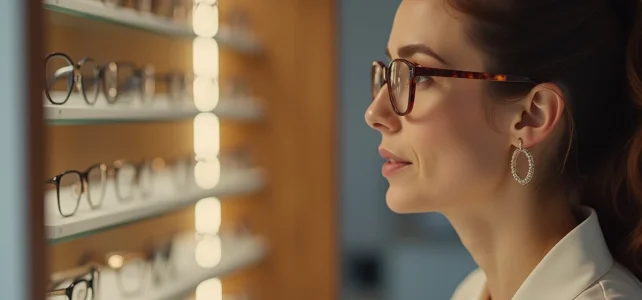
A frame positioned too low on the nose casts a shadow that visually doubles the depth of a hollow dark circle. The problem is not fatigue; it is the physics of light filtered through the lens and redirected towards the infraorbital area. Choosing glasses that conceal dark circles requires thinking in terms of optics, facial morphology, and type of dark circle, not just frame color.
Nose bridge height and nose pad: the adjustment that opticians overlook
The height of the bridge determines where the frame stabilizes on the face. A bridge that is too low causes the glasses to slide down to the tip of the nose, exposing the entire area under the eyes and creating a visual frame that draws attention precisely to where the dark circles are located.
We recommend an adjustable nose pad (screw-in pads rather than a molded bridge) to raise the frame by a few millimeters. This repositioning changes the reading axis of the face for a conversation partner: the gaze is captured by the upper line of the frame instead of descending towards the orbital hollow.
On facial morphologies with a less prominent nasal ridge, keyhole bridge frames systematically slide down. Independent pads help compensate for this lack of support and keep the frame in the optimal position, that is, aligned with the lower eyelid fold or slightly above.

Type of dark circle and frame choice: three situations, three logics
Consumer articles treat dark circles as a uniform block. In reality, the choice of frame directly depends on the type of dark circle, as each alters the geometry of the eye contour differently.
Pigmented dark circles
The brown or purplish coloration of the skin under the eyes does not create a visible hollow. The goal is to divert attention from this colored area. A frame in warm shades (honey, caramel, light tortoiseshell) captures ambient light and reduces the contrast between the pigmented skin and the rest of the face. Black, on the other hand, enhances this contrast with a dark frame effect.
Hollow dark circles
The hollow generates a natural shadow that the frame can either worsen or mitigate. We observe that a thick frame on the lower circle physically masks the hollowed area, provided that the bottom edge of the rim descends sufficiently without resting on the cheekbone. Half-rimmed or drilled frames leave the hollow completely exposed.
Puffy under-eye bags
The swollen volume under the lower eyelid reacts poorly to frames that compress this area. A frame that is too tight presses on the bag and accentuates the relief by creating a bulge effect. It is better to favor a slightly flared lower circle that leaves a space between the lens and the skin.
To deepen the link between frame color and type of dark circle, the choice of glasses that conceal dark circles also involves a colorimetric analysis suited to the skin undertone.
Anti-reflective treatment and rendering in artificial light
A lens without anti-reflective treatment produces greenish or bluish reflections that draw attention to the periorbital area. In artificial light (neon, cold LED lighting), these reflections visually overlap with the dark circles and amplify the impression of fatigue in the gaze.
A multi-layer anti-reflective treatment reduces residual reflections to a negligible fraction of the incident light. The benefit is twofold: the conversation partner sees the eyes through a nearly invisible lens, and the area under the eyes is no longer “illuminated” by distracting reflections.
In photography (video conferencing, portraits), the effect is even more pronounced. Reflections on an untreated lens create white areas that frame the dark circles and highlight them. We find that this technical parameter is rarely taken into account when choosing a pair of prescription glasses, even though it directly influences the appearance of the face on a daily basis.

Selection criteria for an effective dark circle concealing frame
Beyond color and shape, several technical parameters deserve systematic verification in-store:
- The width of the lower circle must cover the entire dark-circled area without resting on the cheekbone, lest it create a second line of shadow below the frame.
- The thickness of the acetate on the lower rim acts as a physical cover: a profile of three millimeters or more masks better than a fine metal wire that highlights the contour.
- The shade of the frame should be close to the skin undertone (golden for warm skin, rosy for cool skin) to blend the transition between the frame and the infraorbital area.
- The total weight of the frame affects stability: a pair that is too light slips more, requiring frequent adjustments, which intermittently exposes the dark circles.
The most common mistake remains choosing a frame solely from a catalog or online, without trying it on from the side. A frontal view is not enough. It is the three-quarter view that reveals whether the lower circle truly covers the dark area or stops too high.
Progressive lenses and head position
Wearers of progressive lenses naturally tilt their heads forward to read through the near vision area. This posture lowers the chin and exposes the area under the eyes more to the conversation partner. Adjusting the pantoscopic angle (the tilt of the lens relative to the face) can partially compensate for this effect by bringing the reading area closer to the natural gaze axis.
The choice of a frame suitable for dark circles is not limited to an isolated aesthetic criterion. Bridge, rim, surface treatment, type of lens: each parameter alters how light interacts with the eye contour. A methodical fitting, in both natural and artificial light, with a profile check, remains the only reliable method to validate that a pair effectively fulfills its camouflage function.