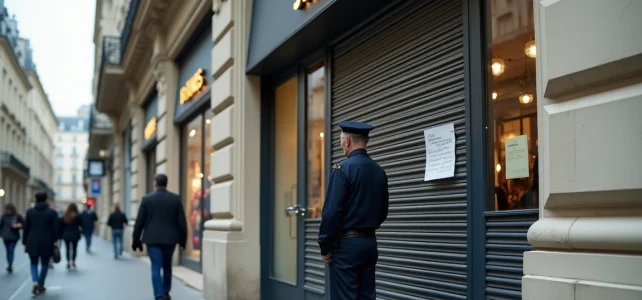
Twenty-six Galeries Lafayette stores placed under safeguard proceedings, a main creditor agreeing to write off a large part of the debt, and a commercial court in Bordeaux at the center of the decisions: the situation of the retail outlets owned by Michel Ohayon goes far beyond a simple inventory of closures. Behind each affected address are jobs, city centers, and complex financial negotiations at stake.
Debt write-off and staggered payments: the financial mechanism that changes everything
Before exploring the affected cities, it is essential to understand what has actually been decided behind the scenes. In February 2024, the Galeries Lafayette group, the main creditor of Hermione Retail (the company of Michel Ohayon), agreed to write off 70% of its claims. The remaining balance, 30%, will be staggered over ten years.
Why is this concession crucial? Because it transforms the very nature of the case. Without this agreement, most stores would have been pushed into outright judicial liquidation. The ten-year staggered payment provides a breathing space for the operators, even though the viability of each retail outlet remains to be individually proven.
This information, often absent from articles that merely list the list of Galeries Lafayette closures, changes the interpretation of the safeguard plan. A restructured debt is not an erased debt, but it avoids the scenario of the curtain falling overnight.
Safeguard proceedings in Bordeaux: what it means in practice
The commercial court of Bordeaux has validated the safeguard proceedings for the 26 stores owned by Michel Ohayon. Have you heard this term before without necessarily knowing what it entails?
The safeguard procedure is aimed at financially distressed companies that are not yet in cessation of payments. In practice, this produces three immediate effects:
- Debts to suppliers and banks are frozen for the entire duration of the procedure, stopping the spiral of unpaid debts.
- Salaries continue to be paid as a priority, directly protecting the affected employees (more than a thousand jobs are at stake across all 26 sites).
- A judicial administrator oversees the management to propose a continuation plan or, failing that, organize orderly sales.

The court issued a ruling that kept almost all the stores open, with one notable exception: the Pau store was closed by court decision. For the other 25, the safeguard has allowed time to negotiate solutions site by site.
Closed Galeries Lafayette: the cities affected by the safeguard
Michel Ohayon acquired twenty-two stores in 2018, to which other retail outlets were added. The 26 sites placed under safeguard proceedings are spread across the country, often in medium-sized cities where these brands played a role in commercial anchoring in city centers.
The affected stores are located in Agen, Amiens, Angoulême, Bayonne, Beauvais, Belfort, Besançon, Caen, Cannes, and several other French cities. The common point among these locations: they are rarely metropolitan flagships but rather medium-sized stores, more exposed to declining foot traffic in city centers and competition from online shopping.
Bordeaux, the seat of the competent court, concentrates judicial decisions, while Marseille and other major French cities remain outside the direct scope of this procedure. The management of the Galeries Lafayette group (distinct from Hermione Retail) retains its own stores, including the flagship in Paris on Boulevard Haussmann.
Pau, the only closure confirmed by the court
Among the 26 stores, only the one in Pau has been subject to a definitive closure pronounced by the commercial court. Employees at this site expressed their fears as soon as the announcement was made, and the closure confirmed the dreaded scenario. For the other cities, the safeguard has acted as a temporary shield, without guaranteeing the long-term viability of each store.
Beyond 2024: Rosny 2 and Beijing, signals of a lasting trend
The restructuring dynamic does not stop with the 26 stores of Hermione Retail. Two other closures illustrate a broader movement.
The Galeries Lafayette store at Westfield Rosny 2 (Rosny-sous-Bois) will close its doors on December 23, 2025. This decision is part of the continuity of the safeguard plan deemed in Bordeaux and shows that adjustments extend beyond the 2024 horizon.
On the international front, the flagship in Beijing closed on May 27, 2024, after thirteen years of operation. Management presented this closure not as a total withdrawal from China, but as a repositioning in response to changing Chinese consumer habits, where online shopping and the search for the best value for money take precedence over the physical department store model.
These two cases reveal a trend: the model of the generalist department store is under pressure everywhere, in France as well as abroad, in suburban shopping centers and in capitals.
Employees and city centers: local consequences to watch
More than a thousand jobs are directly linked to the 26 stores placed under safeguard. The priority given to salary payments during the procedure has limited social urgency, but uncertainty remains high for the staff in place.
For the affected city centers, the closure or decline of a Galeries Lafayette store produces a domino effect. These brands attract pedestrian traffic to neighboring businesses. Their disappearance accelerates commercial depopulation, a sensitive issue already present in cities like Agen, Belfort, or Beauvais.
Local authorities are closely monitoring the negotiations. Some municipalities are seeking buyers or considering converting the premises into mixed-use spaces (retail, public services, housing). Nothing is yet set in stone for the majority of the sites.
The agreement on the write-off of 70% of the claims has postponed the catastrophic scenario, but the viability of each store will depend on in-store traffic, negotiated rents, and Hermione Retail’s ability to stabilize its business model over the ten-year staggered payment period. The case remains open, and each affected city will experience a different outcome.